1. Find your own average
Your iPhone has been counting for as long as you have carried it. In the Health app, open Browse, Activity, Steps to see your recent days and weeks. In Stridune, the History screen shows your averages for 7, 30 and 90 days side by side.
2. Set the goal a little above it
If your 30-day average is 6,800, a goal of 7,000 is a stretch you can feel and still reach. A goal of 10,000 would mean failing on most days from the first week, and a streak that never gets started.
- Goal met
- Missed
- Goal: 7,000
3. Raise it when it has become easy
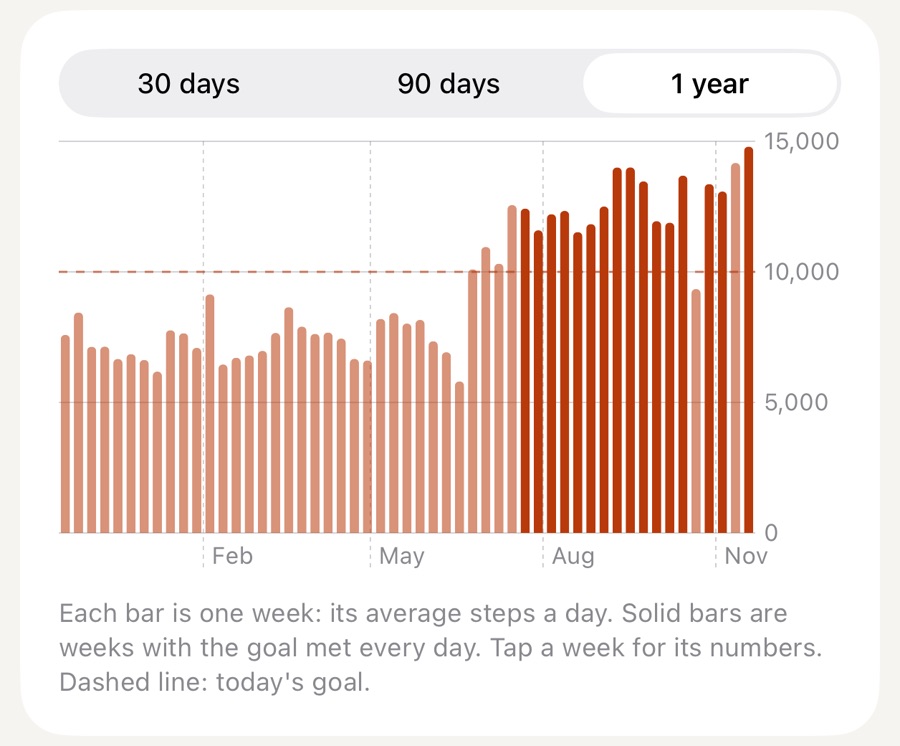
When you have reached the goal on most days for a few weeks, add a little, for example 500 steps. In Stridune you can set any goal from 500 to 100,000 steps, and days that are already finished stay as they were.
4. Decide what happens on a bad day
Every goal is missed sometimes. If one missed day sets you back to zero, the goal starts to feel like a punishment. Rest days, a pause for illness and the chance to recover a missed day keep one bad day small. In Stridune you choose how strict these rules are. How Stridune’s streak rules work.
Is 10,000 steps the right number?
It is a round, popular target, and it is a fine goal if it fits your day. It is not an official health threshold. The World Health Organization’s recommendation for adults is given in minutes, not steps: at least 150 minutes of moderate activity a week.
Regular walking is good for health and mood. How much is right for you depends on your body and your life, and if you have a medical condition, on what your doctor says. This page is about building a habit. It is not medical advice.
Source for the WHO recommendation, read on 19 November 2026: World Health Organization, fact sheet “Physical activity”, who.int/news-room/fact-sheets/detail/physical-activity. The week shown is an example.